
Original 1934 F1 German Grand Prix Nürburgring First WW2 Nazi Silver Arrows Race
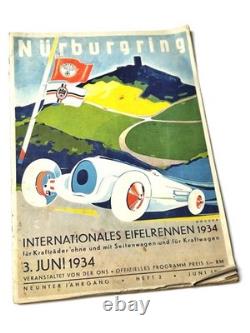
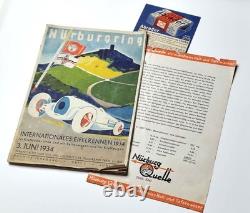
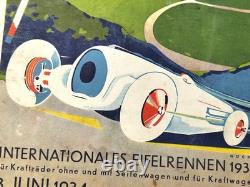
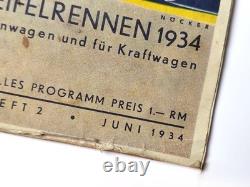
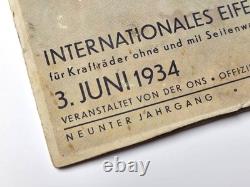
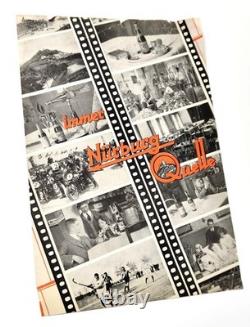
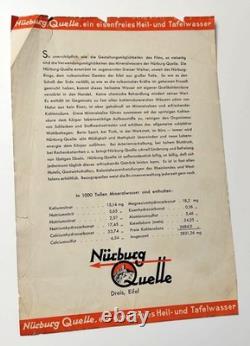
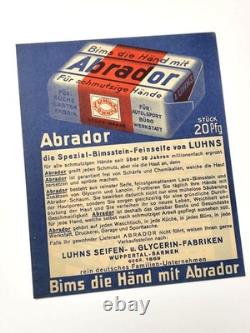
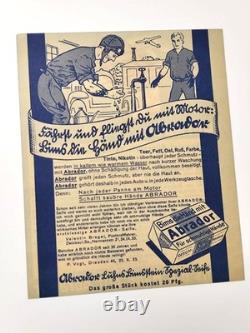
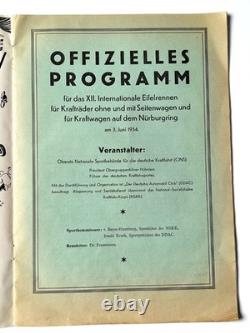
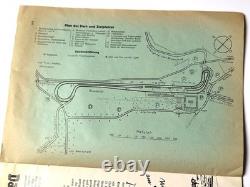
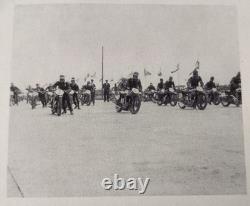
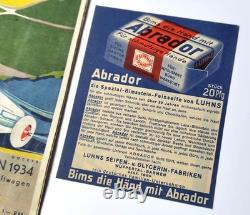
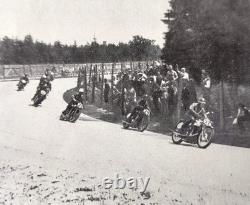
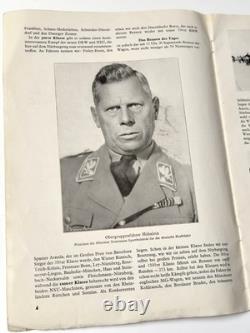
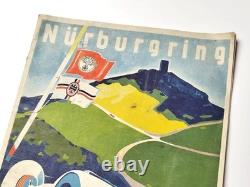

SILVER ARROWS FIRST APPEARANCE AT THE 1934 GERMAN GRAND PRIX. Original Nürburgring Nordschleife Program + Two Original Inserts. WARNING This historic program contains period images, language and historic text which some may find distressing. A complete official 1934 German Grand Prix program, including the two original inserts from inside the program on race day.
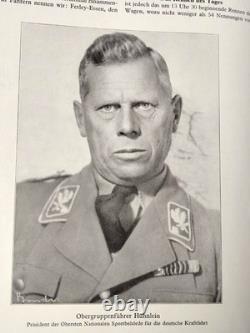
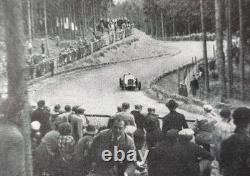
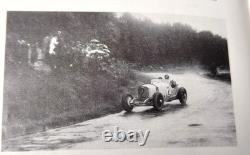
This program is symbolic of the escalating use of Nazi party-political propaganda, conceived and designed by Adolf Hitlers Wehrmacht, and in this program the Nazi Party introduces Obergruppenführer Adolf Hühnlein with a full page biography and military photograph. As the later Korpsführer (Corps Leader) of the National Socialist Motor Corps (NSKK), Hühnlein acted as the motoring impresario for the Third Reich. Adolf Hitlers government funded the Mercedes-Benz racing programme for six years, from 1933 until the outbreak of World War II in 1939. The Mercedes-Benz Silver Arrows (German: Silberpfeile) made their historic debut on this day 3rd June 1934 at the Nürburgring. Driving the new W 25 model, Manfred von Brauchitsch won the race and set a new track record, marking the birth of this legendary racing era. The cars were christened Silver Arrows primarily due to an accidental weight reduction tactic that became legendary. Grand Prix rules introduced in 1934 set a maximum weight limit of 750 kg (excluding fuel and tyres). The night before the race, the Mercedes-Benz W 25 was found to be exactly one kilogram over the limit. To help shed the excess weight, race manager Alfred Neubauer ordered the traditional German white paint to be sanded off overnight, revealing below the shining bare aluminium bodywork.The unpainted, silver-coloured cars passed scrutineering and took to the track, winning its first race and leading press and radio commentators to dub the remarkably fast vehicles "Silver Arrows". After taking office, Adolf Hitler paid an annual 500,000 Reichsmark (RM) stipend to Mercedes-Benz to help showcase Germany's industrial superiority through Grand Prix racing. This state sponsorship ensured the legendary Silver Arrows would dominate European Grand Prix racing for the next five years.
During the Second World War, Daimler-Benz stood at the very core of the German war economy. The firm transformed its legendary engineering capability into a military production powerhouse. Its facilities in Untertürkheim, Mannheim, Gaggenau, Berlin-Marienfelde and Sindelfingen produced engines, trucks, aircraft components, and specialized marine diesels for the Nazi regime.The company collaborated directly with the Wehrmacht, Luftwaffe and Kriegsmarine to meet Germany's escalating military needs. Mercedes-Benz vehicles served as staff cars, troop carriers, and logistical workhorses, while its DB series aircraft engines powered frontline fighters like the Messerschmitt Bf 109 and Bf 110.
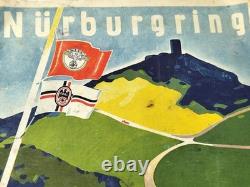
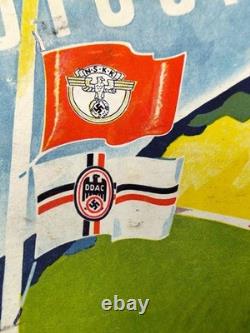
The wartime portfolio included the iconic Mercedes-Benz 170V - the most produced pre-war model and heavily used by the military - as well as the 260D (the world's first diesel passenger car), and the powerful 320 (W142), often referred to as the "golden age chassis" for upper-class transport and military adaptation. The larger 540K and 770K Großer Mercedes became synonymous with Nazi elite prestige, often seen in official parades and propaganda. On the heavy side, trucks like the L1500A, L3000S, and the versatile LG3000 formed the backbone of Germany's field logistics. Equally vital were Daimler-Benz's aircraft engines, especially the DB 601, DB 603, and DB 605, which played a central role in German air superiority strategy. Marine and tank engines such as the MB 507 and MB 509 were used in Schnellboote (E-boats) and experimental heavy armor. These developments were led by some of Germany's foremost engineers, including Hans Nibel, Fritz Nallinger, and Wilhelm Kissel, all of whom shaped the golden age of German automotive and military engineering. Their correspondence, approvals, and technical reports-often bearing names like Heinrich Remmers-are now of immense interest to collectors and historians alike. The 1937 season would feature the most powerful Grand Prix cars of the pre-war era; the Mercedes-Benz W125 producing nearly 650 bhp, power the likes of which would not be seen again in Grand Prix racing until the turbo-charged era of the 1980s. Matejko was a prominent Austrian-born graphic artist and illustrator notable for his dynamic press illustrations and vivid propaganda posters. His career spanned several eras of German history, where he became one of the most successful press illustrators for the Berliner Illustrirte Zeitung. During the 1930s and 40s he became a key artist for the Nazi regime, producing posters for the 1936 Olympics and extensive military illustrations for the magazine Die Wehrmacht.He designed iconic theatrical posters for early cinema, including the original poster for Fritz Lang's Dr. In 1928, he was invited on the first transatlantic flight of the Graf Zeppelin, where he created a unique artistic record of the historic voyage. On this program Matejko prominently positions the Reichs DDAC and NSKK flags flying together. In 1934, the DDAC (Der Deutsche Automobil-Club) flag and its associated insignia represented the total Gleichschaltung (co-ordination) of German automotive culture under Nazi rule.
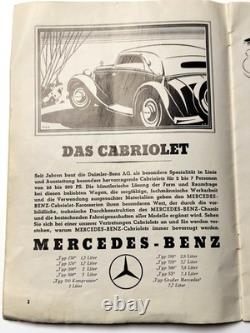
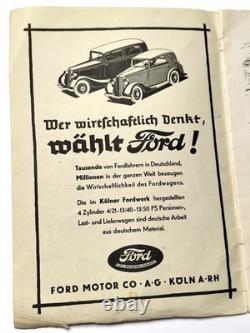
This was the pivotal year when the DDAC became the sole authorised automobile club in Germany, forcibly absorbing all other major clubs like the ADAC and AvD. By September the DDAC had grown into a mass organization with over one million members. The flag signaled that independent motoring associations no longer existed with every driver now under the centralized control of the Nazi state. The NSKK (National Socialist Motor Corps) flag also symbolized the organization's newfound independence and direct subordination to Adolf Hitler. This shift was a direct result of the Night of the Long Knives (Röhm Purge) in June 1934.After the purge, the NSKK was separated from the SA, the Sturmabteilung, also known as the Brownshirts or Stormtroopers, and promoted to an independent paramilitary formation of the Nazi Party (NSDAP), reporting directly to the Führer. Like all party flags, the NSKK insignia utilized the red, white, and black color scheme to signify its connection with the Imperial German colors and the "social thought" of the movement. Ford Motor Company, Shell, Mercedes-Benz, Hoppecke Batteries, Kinonglas, Bitburger Simonbrau, Ganzstahl Karosserien, Kompressol Oel, Konigsbacherbrau, Amtenbrink Koln, Continental Tyres. 16 pages, sized approximately 30cm x 20cm (approximately 12" x 8"). Weight approximately 95 grams prior to packaging.
1 Sized approximately 29 cm x 20cm (approximately 11" x 8"). 2 Sized approximately 15cm x 12cm (approximately "6 x 5").
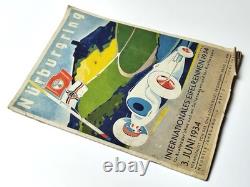
Program generally in good condition, published on light paper stock plus additional very light paper competitor entry forms and advertising, with a heavy color printed card cover. This ninety year old program survived not only the German Grand Prix of 1934 but went on to survive WWII so has SIGNS OF VISIBLE WEAR AND TEAR including some light creasing, light folds, bumps, surface scuffs, some separation / minor tears, with some foxing and discoloration throughout.
Unusually, there is no handwriting entries or graffiti in this program. The two inserts are in good condition with some visible signs of wear and tear to the larger insert with some separation and minor tears.
The earliest, original and now impossible to find piece of Silver Arrows racing history. Please note any import duty is the buyers responsibility. My previous three UPS deliveries to my US based customers arrived door to door in 4 days.